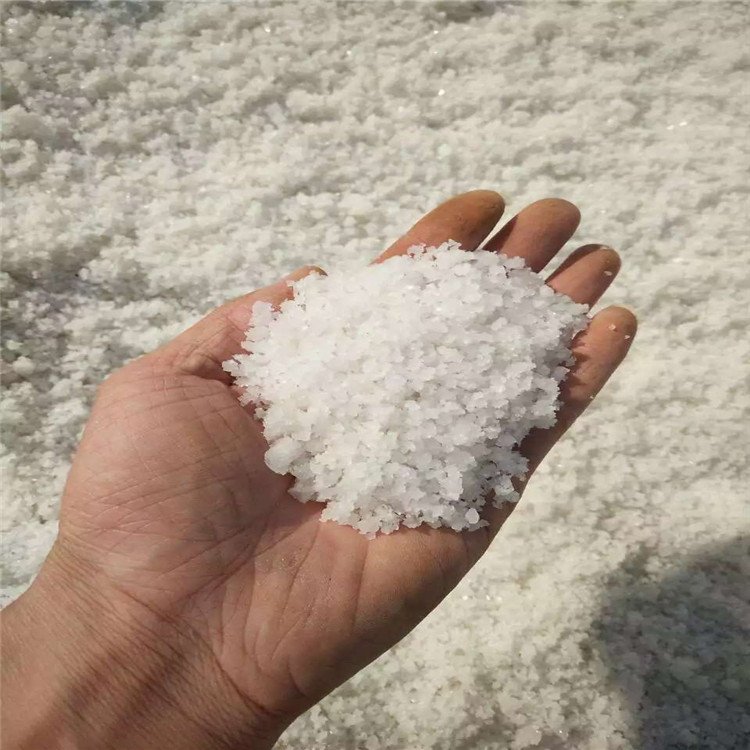
Product at a glance
- Formula
- NaCl
- CAS
- 7647-14-5
- Common forms
- Granular, powder, or controlled particle size matched to the process
- Buyer documents
- Verify the offered grade with TDS, SDS, and a batch COA
What Is Refined Industrial Rock Salt?
Refined industrial rock salt is a sodium chloride product made from underground salt deposits and processed for industrial use. Depending on the geology and production route, the producer may mine solid salt or dissolve the deposit to create brine. Purification, evaporation, crystallization, dewatering, drying, and screening can then be used to produce a more consistent salt with controlled sodium chloride content, moisture, insoluble matter, impurity levels, and particle size.
“Industrial salt” is a use category, not a food designation and not one universal specification. A product supplied for chlor-alkali manufacturing may have different critical limits from salt used for textile processing, water-softener regeneration, drilling brine, or winter maintenance. Buyers should define the end use and approve the product against an agreed specification, analytical methods, and batch certificate of analysis.
Industrial salt must not be used as food merely because sodium chloride is its main component. Food, feed, pharmaceutical, and regulated water applications can require specific manufacturing controls, approvals, certifications, additives, and labeling. Suitability must be established for the exact product and destination market.
How Refined Rock Salt Is Produced
Rock salt originates in underground evaporite formations. A producer may extract solid material through mining or use solution mining to bring brine to the surface. The selected route depends on the deposit, geography, equipment, and desired product.
For refined salt, raw brine is commonly clarified and treated to reduce suspended solids and selected impurities before crystallization. Evaporation concentrates the brine until sodium chloride crystals form. The crystals are separated from the mother liquor, dried to the required moisture level, and screened into target particle-size ranges. Some products are further compacted into tablets or granulated for a specific use.
Process control shapes product consistency. Raw-brine composition, purification chemistry, evaporator conditions, centrifuge performance, dryer operation, and screening efficiency can all affect assay, calcium, magnesium, sulfate, iron, moisture, whiteness, and particle distribution. For continuous industrial users, control from lot to lot may matter more than an unusually strong result on a single certificate.
Buyers should also ask whether processing aids or additives are used. An anti-caking agent acceptable in one industrial process may be undesirable in another. Additive status, type, and maximum level should be disclosed where relevant and included in application validation.
Main Uses of Refined Industrial Rock Salt
Chlor-Alkali and Basic Chemical Production
Sodium chloride brine is a primary feedstock for chlor-alkali production, which generates chlorine, sodium hydroxide, and hydrogen. The salt quality can influence brine-treatment demand and electrolyzer operation. Calcium, magnesium, sulfate, insoluble matter, and selected metals may increase reagent consumption, create solids, or interfere with process equipment.
The correct incoming specification depends on the plant’s brine purification system, membrane or cell technology, operating targets, and process licensor requirements. A generic industrial salt standard should not replace a plant-specific technical review. Large chlor-alkali users also need reliable logistics, unloading capacity, safety stock, and contingency supply because a salt interruption can constrain the entire production chain.
Ion Exchange and Water Softening
Refined sodium chloride can be used as a regenerant for selected sodium-cycle ion exchange systems. Water-softener applications generally benefit from low and consistent insoluble matter because dirt and mineral residue can accumulate in the brine tank or interfere with small valve passages.
Not every industrial rock salt grade is suitable for direct use in a water softener. Particle form, dissolution, calcium and magnesium impurities, additives, and application-specific approvals should be reviewed. Water treatment serving food plants, public systems, healthcare, or other regulated operations may have additional chemical-certification requirements.
Textile Dyeing and Finishing
Salt is used in selected dyeing processes to adjust bath ionic strength and support dye transfer within the fiber-dye system. The required dose and acceptable impurity profile depend on fiber, dye class, equipment, water quality, and recipe. Calcium, magnesium, iron, color, or insoluble matter may affect shade reproducibility, fabric appearance, filtration, and cleaning.
Textile processors should qualify salt through laboratory dyeing and production trials. The test should evaluate not only chemical assay but also color difference, spots, sediment, dissolution, and performance in the actual water supply. A salt that works in one dye house is not automatically equivalent in another process.
Detergents and General Manufacturing
Sodium chloride is used as a formulation or process component in selected detergents, cleaners, and industrial products. Requirements can include particle size, dissolution rate, moisture, color, or limits on ions that interact with surfactants and additives. Product developers should validate changes against both the manufacturing process and the finished-product specification.
Industrial rock salt can also serve as a raw material for other sodium salts. In downstream conversion, some impurities may carry through or become concentrated. Manufacturers of higher-value derivatives should set the salt specification by working backward from final-product limits and purification capability.
Leather, Metal Processing, Drilling, and Process Brines
Industrial salt appears in leather preservation and processing, selected metal heat-treatment systems, drilling fluids, and general process brines. Each application uses sodium chloride differently and therefore has a different critical impurity profile. A process that needs clear brine may emphasize insoluble matter; a high-temperature or metal-contact process may focus on sulfate, calcium, magnesium, or trace metals.
Process owners should review materials compatibility, environmental discharge, and local rules. The use of a product in one industrial sector does not prove its suitability for another.
Deicing and Winter Maintenance
Sodium chloride is widely used for pavement deicing where climate and operating conditions are appropriate. It works by forming brine and lowering the freezing point of water. Performance depends on pavement temperature, particle size, spreading rate, traffic, moisture, and timing. At lower temperatures or under difficult conditions, a different material or blended strategy may be required.
Road authorities and private sites should calibrate spreading equipment and avoid excessive application. Chloride can affect vehicles, bridges, reinforced concrete, vegetation, soil, and receiving water. Storage pads, runoff controls, and accurate recordkeeping support responsible use.
Which Specifications Matter?
Sodium chloride assay is the starting point because it indicates the main active component. It is not the only measure of value. Moisture affects active-content calculations, flowability, and freight efficiency. Water-insoluble matter adds filtration and cleaning load. Calcium and magnesium can promote precipitation or scale and increase downstream purification demand. Sulfate, iron, color, and trace elements may be important in specific chemical or textile processes.
Particle size influences dissolution, dust, conveying, mechanical spreading, and segregation. A narrow range can help automated feeding, while a broader range may be acceptable for manual dissolution. Buyers should describe particle requirements using an agreed sieve method instead of vague terms such as “coarse” or “fine.”
Whiteness and visual appearance are useful for identifying unusual contamination, but they do not replace chemical analysis. A bright white salt can still have an impurity profile that is unsuitable for a sensitive process. Conversely, a non-appearance-critical use may not benefit from paying extra for a cosmetic specification.
Analytical methods should be part of the agreement. Different sample preparation and test methods can yield different results, especially for moisture and trace impurities. Critical limits, test standards, sampling, retesting, retained samples, and dispute resolution should be defined before routine supply begins.
How to Compare Industrial Salt Suppliers
First, normalize the commercial basis. Compare the same grade, particle size, packaging, net weight, Incoterm, tax basis, destination, and documentation. Where assay and moisture differ, calculate delivered cost per unit of active sodium chloride.
Second, include process cost. A less expensive salt may require more brine purification chemicals, produce more filter solids, create extra tank cleaning, or increase downtime. Total-use cost can include raw material, freight, unloading, storage, handling loss, treatment, waste disposal, and production variability.
Third, evaluate supply reliability. Ask about raw-material source, normal capacity, peak-season availability, inventory policy, lead time, backup logistics, and change notification. Critical users may need safety stock, contracted allocation, or a second approved source.
Fourth, review quality systems and documents. A supplier should provide a technical data sheet, safety data sheet, representative COA, packaging specification, and traceability information. If independent testing is required, agree on the laboratory, sampling point, method, frequency, and allocation of cost.
A staged qualification reduces risk:
- Review the supplier and product documentation.
- Test a representative sample against the agreed methods.
- Run a laboratory or plant trial.
- Evaluate a limited commercial shipment for packaging and consistency.
- Approve routine supply with incoming inspection and change control.
Packaging and Logistics
Industrial salt can be supplied in small bags, bulk bags, or bulk transport, subject to producer and destination capabilities. The choice affects warehouse space, forklift or crane needs, unloading speed, moisture exposure, labor, and packaging disposal.
For bagged exports, confirm bag construction, liner, printing, net weight, pallet type, wrapping, container loading, and moisture control. Long ocean routes and humid destinations may require stronger protection than domestic truck delivery. Loading quantity should be confirmed for the actual bag and pallet plan rather than treated as a universal number.
For bulk deliveries, the receiving system must control dust, foreign material, and rain entry. Conveyors, silos, pits, and unloading areas should be designed for the chosen particle size and delivery vehicle.
Storage, Handling, and Environmental Management
Store refined industrial salt in a clean, dry, covered, and ventilated area. Protect it from rain, damp floors, and contamination. Although sodium chloride is usually less hygroscopic than calcium chloride or magnesium chloride, moisture, fine particles, compression, and long storage can still cause caking. Keep bags intact, use pallets where appropriate, and rotate inventory.
Bulk handling can produce dust. Use suitable engineering controls and follow the current SDS for eye, skin, and respiratory protection. Concentrated brine may irritate eyes or damaged skin. Spilled salt and saline wash water should be managed so that they do not enter soil, drains, or surface water in violation of local requirements.
Shipping classification, tariff code, labels, and import documents should be verified for the exact product and destination. Compliance claims should be supported by current documents, and industrial salt must remain clearly segregated from food materials.
Frequently Asked Questions
Is refined industrial rock salt edible?
No. Industrial salt is manufactured and controlled for industrial use. Food salt is subject to separate safety, licensing, additive, and labeling requirements. Industrial material must not enter the food chain.
What is the difference between rock salt and sea salt?
The main difference is source and production route. Rock salt comes from underground deposits, while sea salt originates from seawater or related brines. After refining, either source can yield a sodium-chloride product, but impurity profile, particle form, regional availability, and process performance may differ. Compare actual specifications rather than source alone.
Is the highest NaCl assay always the best choice?
Not necessarily. High assay provides more active sodium chloride per unit mass, but a specific process may be more sensitive to calcium, magnesium, sulfate, iron, insoluble matter, moisture, or particle size. The best grade meets the critical limits at the lowest reliable total cost.
What should be included in an RFQ?
State the end use, required specification and methods, particle size, packaging, volume, destination, Incoterm, delivery schedule, documentation, labeling, inspection, and trial requirements. This makes supplier offers easier to compare.
Conclusion
Refined industrial rock salt is a basic raw material with application-specific performance requirements. Assay, moisture, insoluble matter, calcium, magnesium, sulfate, particle size, packaging, and supply consistency can all affect plant economics. Clear specifications, realistic trials, reliable documentation, and total-cost analysis help buyers select a grade and supplier that will perform consistently beyond the first shipment.