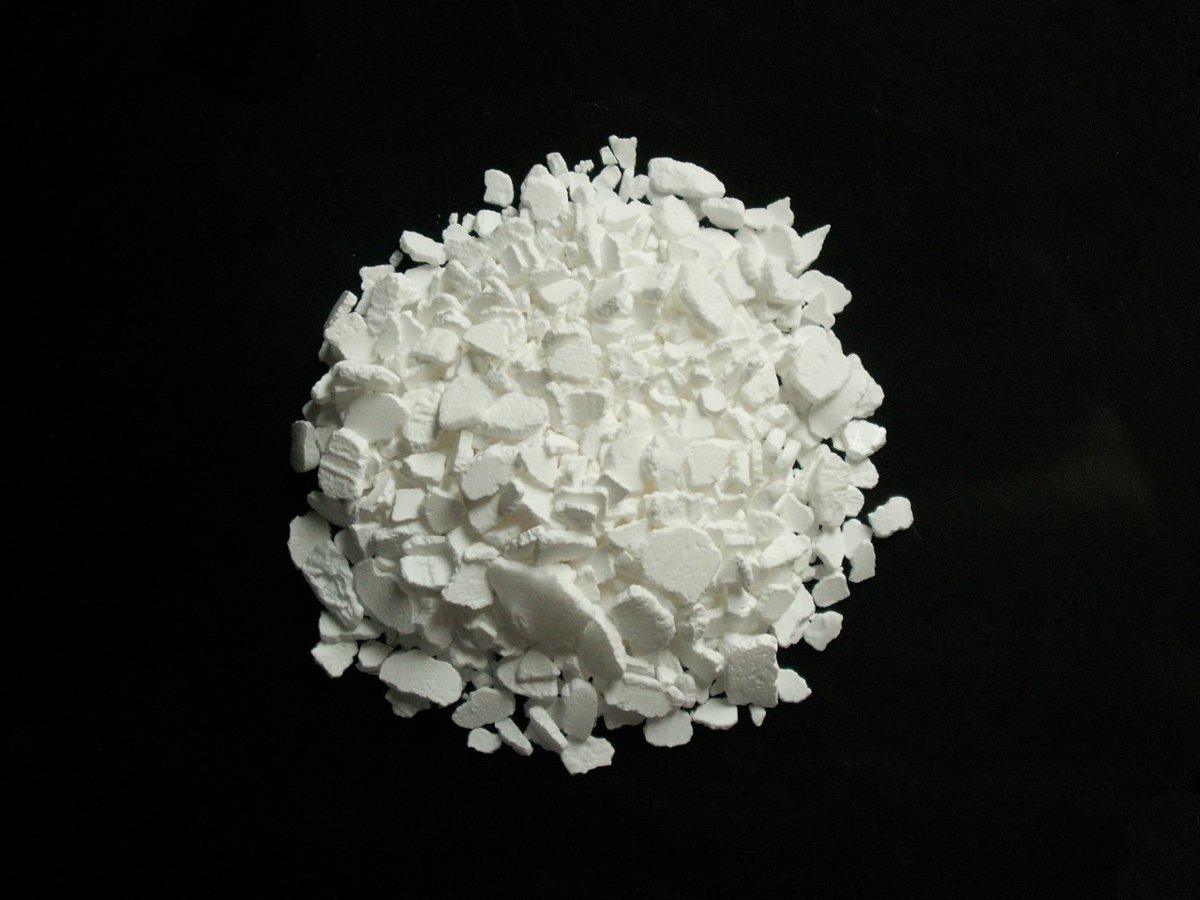
Product at a glance
- Formula
- CaCl₂·2H₂O
- CAS
- 10035-04-8
- Common forms
- Flakes, granules, lumps, or powder; confirm the offered form
- Buyer documents
- Verify the offered grade with TDS, SDS, and a batch COA
What Is Calcium Chloride Dihydrate?
Calcium chloride dihydrate is a hydrated form of calcium chloride with the formula CaCl₂·2H₂O and CAS number 10035-04-8. Each formula unit contains two molecules of water of crystallization. The product is generally supplied as white or off-white flakes, granules, lumps, or powder. It dissolves readily in water and is hygroscopic, although its composition and behavior differ from those of anhydrous calcium chloride.
Industrial calcium chloride dihydrate is used in winter maintenance, dust control, refrigeration brines, selected construction processes, desiccant formulations, and chemical manufacturing. Commercial grades may differ in CaCl₂ assay, insoluble matter, alkalinity, particle size, appearance, and trace impurities. A buyer should therefore specify the required performance and review the technical data sheet and batch certificate of analysis for the actual grade offered.
Why Buyers Choose the Dihydrate Form
The dihydrate form can provide a practical balance between active CaCl₂ content, physical form, handling, dissolution, and delivered cost. Some production processes yield durable particles or flakes that are convenient for mechanical spreading and manual dosing. For applications that do not require the maximum active content per kilogram, a dihydrate grade may be economically and operationally suitable.
Calcium chloride dihydrate lowers the freezing point of water and can form concentrated brines. It also absorbs moisture from the air, which supports dust-control and selected humidity-control uses. These same properties make packaging and storage important: damaged liners, humid warehouses, and extended exposure after opening can result in caking, wet product, or leakage.
The product releases heat when it dissolves, although the observed temperature rise depends on concentration, water temperature, addition rate, and mixing. Operators should use a controlled solution-making procedure and follow the current safety data sheet. Familiarity with the chemical is not a substitute for appropriate eye and skin protection.
Major Applications of Calcium Chloride Dihydrate
Road Deicing and Anti-Icing Programs
Calcium chloride dihydrate can be used directly or as an ingredient in blended deicers. Once sufficient moisture is available, the salt forms brine and depresses the freezing point. Solid particles may support deicing after snow or ice has formed, while solutions or pre-wetted solids can be used in preventive maintenance programs.
Field performance varies with pavement temperature, air temperature, precipitation, traffic, particle size, application timing, and spreading accuracy. A winter maintenance plan should use calibrated equipment and locally validated rates. Over-application increases cost and chloride loading without guaranteeing a proportional improvement in safety.
Chloride-based products can affect vehicles, exposed metals, reinforced structures, roadside vegetation, soil, and water. Agencies and site operators should assess sensitive assets, control storage and runoff, and select the least amount that achieves the operational objective.
Dust Suppression on Unpaved Surfaces
Because calcium chloride retains moisture, it may help reduce dust on unpaved roads, mine access routes, construction sites, and storage yards. The treatment can help keep fine particles at the road surface and may reduce the need for frequent water spraying under suitable conditions.
Results depend on the soil, proportion of fines, grading, drainage, weather, traffic, and uniformity of application. A trial section allows the user to determine whether the treatment is appropriate and to establish a practical maintenance interval. Environmental permissions and stormwater requirements should be checked before use.
Refrigeration and Process Brines
Calcium chloride solution is used as a secondary refrigerant in some cooling systems. A properly selected concentration can remain liquid below the normal freezing point of water, allowing heat to be transferred between process equipment and the refrigeration plant.
System design must consider more than freeze protection. Solution viscosity, density, pumping energy, heat transfer, corrosion, water quality, seals, and construction materials influence reliability. Concentration should be checked periodically because leakage, evaporation, and water additions can alter brine performance. The user should follow equipment-provider and engineering recommendations rather than apply a generic concentration table without review.
Construction and Industrial Processing
Calcium chloride can serve as an ingredient or process aid in selected construction-material, mining, oilfield, and chemical applications. The acceptable grade depends on how chloride, alkalinity, insoluble matter, and other ions affect the formulation. Applications involving reinforced concrete or exposed metals require particular care because chloride may contribute to corrosion and may be restricted by applicable codes or specifications.
In chemical production, the composition of the incoming salt may affect reaction yield, filtration, product color, or downstream crystallization. A grade suitable for deicing is not automatically suitable for a sensitive manufacturing process. Technical and plant-scale validation should precede substitution.
Moisture-Absorbing Products
Calcium chloride dihydrate remains hygroscopic and may be used in selected desiccant or moisture-absorber formulations. Compared with an anhydrous grade, it contains water of crystallization, so absorption capacity per unit mass and formulation economics will differ. The designer should evaluate target humidity, absorption rate, duration, packaging permeability, liquid containment, and product compatibility.
Dihydrate vs Anhydrous Calcium Chloride
The two forms should be compared on an application basis. Anhydrous calcium chloride generally supplies more active CaCl₂ per unit mass and may be preferred when high assay or strong moisture absorption is central to the process. Calcium chloride dihydrate may offer a suitable particle form, availability, handling profile, or total delivered cost for other applications.
A simple price-per-ton comparison is misleading when assays differ. Buyers can calculate the delivered cost per unit of active CaCl₂, then add operational factors such as dissolution loss, insoluble residue, caking, dust, packaging disposal, and labor. In a formulation, both materials should be tested at an equivalent active dose rather than an equal gross weight.
Substitution also changes the amount of water introduced with the raw material. That difference may be minor in a large aqueous system but important in moisture-sensitive manufacturing. Process engineers should recalculate the material balance and verify final performance before changing grades.
How to Build a Purchasing Specification
Begin with the application and identify the attributes that influence performance. A practical specification may include CaCl₂ assay, particle form, particle-size range, insoluble matter, alkalinity, relevant ion limits, packaging, and agreed analytical methods. Requirements that do not affect the process can add cost without adding value, while an omitted critical impurity can create repeated production problems.
Particle form deserves specific attention. Granules and flakes may provide predictable mechanical spreading and reduced dust. Powder can dissolve rapidly but may be harder to handle in open systems. For automated feeding, the buyer should test flowability, bridging, bulk density, and performance after normal warehouse storage.
Documentation should include a technical data sheet, safety data sheet, batch certificate of analysis, packing specification, and traceability information. Claims such as food grade, pharmaceutical grade, or compliance with a named standard must be supported by current documents that cover the exact product, manufacturing site, and intended market.
For a new supplier, use a staged approval process:
- Review the specification and supporting documents.
- Test a representative sample using agreed methods.
- Run a laboratory or process trial under normal conditions.
- Place a limited commercial order to evaluate packaging and consistency.
- Approve routine supply with defined incoming inspection and change notification.
Requesting a Useful Quotation
A precise RFQ helps suppliers recommend the correct grade and avoids time lost on non-comparable offers. State the application, required assay and form, particle size, critical impurity limits, packaging, quantity, delivery location, destination port, Incoterm, document requirements, and expected delivery window.
Compare quotations under the same commercial basis. Confirm whether prices include pallets, inspection, local transport, export packing, or other services. For ocean shipments, ask about container loading, moisture protection, pallet type, and the effect of route and season on packaging selection.
The lowest quoted price may not provide the lowest operating cost. Product that cakes heavily, creates excess residue, or varies from lot to lot can increase labor, filtration, cleaning, and downtime. A total-cost comparison should capture these operational effects.
Storage and Safe Handling
Store calcium chloride dihydrate indoors in a cool, dry, ventilated location. Keep bags protected from rain, floor moisture, and condensation, and avoid damage during forklift or crane handling. Reseal partial bags promptly and use first-in, first-out inventory control.
When preparing solutions, add the product slowly to water with agitation and temperature monitoring. Personnel should follow the supplier’s SDS and use suitable personal protective equipment. Dust or concentrated solution may irritate the eyes and skin. Spills should be contained and managed in accordance with the site procedure and local environmental requirements.
Shipping classification, labeling, customs codes, and import documents should be verified for the actual grade and destination. Requirements can differ by formulation and market, so unrelated documents should not be reused without confirmation.
Frequently Asked Questions
What forms are available?
Calcium chloride dihydrate is commonly sold as flakes, granules, lumps, or powder. Availability and particle-size ranges depend on the producer. Select the form that matches the feeder, dissolver, spreader, and dust-control needs.
Does calcium chloride dihydrate cake?
Yes. It can absorb moisture from humid air. Packaging integrity, warehouse humidity, condensation, storage time, and stacking pressure all influence caking.
Is assay the only important quality parameter?
No. Insoluble matter, alkalinity, particle size, relevant impurities, packaging, and batch consistency may be equally important. The right list depends on the application.
Can industrial grade material be used in food or drinking-water applications?
No, not without specific approval and documentation for that use. Industrial grade material must not be treated as food, pharmaceutical, or drinking-water grade merely because it has the same chemical name.
Conclusion
Calcium chloride dihydrate is a versatile material for deicing, dust control, brine systems, moisture management, and industrial processing. A successful purchase depends on matching assay, physical form, impurities, and packaging to the actual process. Product documentation, representative testing, and total-cost evaluation are more reliable than selecting on headline assay or price alone.